
New article by Dr Thomas Hammond calls for bridging theoretical divides in language education research
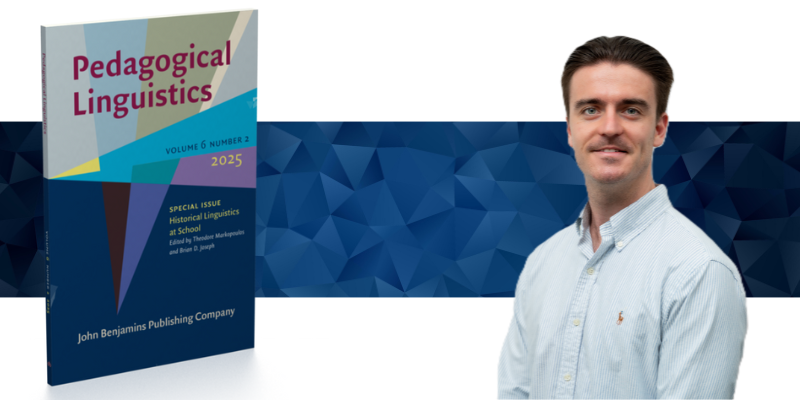
What explains how we learn a second language? A new paper by Dr Thomas Hammond, published in Pedagogical Linguistics, shows the practical benefits of combining competing theories to understand how people learn additional languages. Dr Hammond suggests that instead of treating generative and usage-based theories of second language acquisition as rivals, they should be seen as complementary for improving language teaching. Generative approaches help identify what linguistic features are especially difficult for learners, while usage-based models explain how learners can gradually overcome these difficulties through analogy, schematisation and practice. The article draws on the teaching of English articles and French wh-questions as examples, demonstrating how generative theory highlights what should be taught and usage-based pedagogy suggests how to teach it. This paper reframes long-standing theoretical divides around a shared pedagogical goal, encouraging collaboration across traditions, and proposing a more unified “pedagogical linguistics” to close the gap between linguistic theory and classroom practice.
Dr Thomas Hammond is Lecturer in Language Education/TESOL in the Centre for Language and Education Research at the University of Leeds. He has a BA in English Language and Italian (Manchester) and an MA and PhD in Applied Linguistics (Sheffield). He has taught English as a Foreign Language (EFL) at high schools and private language schools in Italy and English for Academic Purposes (EAP) in UK universities. This extensive teaching experience has informed his current research in second language acquisition and language description and their relationship with language pedagogy.
Related News
CLER Strengthens Research Culture Through Early Career Capacity Building
Dr Elina Stylianou and two School of Education Postgraduate Researchers, Xuechun Huang and Hongyi Zhao, have recently had a blog post published on the BERA webpage. Titled ‘Why should early career researchers organise an academic conference?’, the contribution shares insights which are based on last year's BAAL Vocab SIG conference, led by Dr Yen Dang. The...
New Book: New Words, New Meanings
New Book: New Words, New Meanings: Supporting the Vocabulary Transition from Primary to Secondary school This book for teachers, written by Professor Alice Deignan and Marcus Jones, explains the nature of the language challenge students face in early secondary school. It has come out of Professor Alice Deignan's large ESRC project, Linguistic Challenges of the...
New book: Listening without borders
What does it take for people to encounter one another ethically when practices, worldviews and imaginations clash? Professor Maggie Kubanyiova's new publication, Listening Without Borders (co-edited by Dr Parinita Shetty) brings together more than 40 academics, arts practitioners and educators to attend to these questions through interdisciplinary encounters. The book invites a new way of engaging...